 NAmur Research Institute for LIfe Sciences
Engineering anti-infective agents against SARS-CoV-2 variants: success of an interdisciplinary collaboration at NARILIS
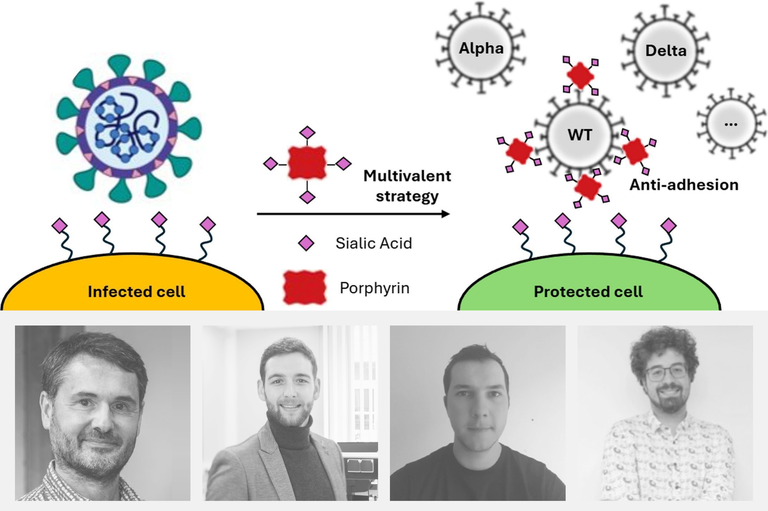
The research teams led by Prof. Stéphane Vincent (UNamur, Bio-organic chemistry, CBO) and Prof. Jonathan Douxfils (UNamur, Clinical Pharmacology and Toxicology, URPC) joined forces in an innovative project aimed at developing anti-adhesion strategies against SARS-CoV-2 variants using multivalent glycosylated molecules. These agents are designed to interfere at the earliest stage of viral infection, by preventing viral attachment and entry into host cells, with potential applications in both curative and prophylactic contexts.
Vivian Lioret, postdoctoral researcher at CBO, designed and synthesized a series of porphyrin-based sialic acid glycoclusters, fine-tuning linker length, polarity and rigidity, to maximize multivalent interactions with viral surface proteins. The anti-infective activity of these glycosylated porphyrins was then evaluated using a pseudovirus-based neutralization test (pVNT) developed by Constant Gillot, postdoctoral researcher at URPC. Neutralizing potencies were measured against several pseudotyped SARS-CoV-2 variants, including wild-type, Alpha, Delta, JN.1 and KP.3, as well as against the live Delta variant.
The results of this work have just been published in Bioorganic Chemistry (Lioret et al., 2026).
Unlike classic small-molecule antivirals, these glycoclusters are structurally large and do not conform to conventional drug-likeness criteria. Acting as anti-adhesion “decoys”, their promise lies in local administration, for example via intranasal sprays, to limit viral accumulation at the lung epithelium, thereby offering a complementary approach to existing antiviral strategies.
From left to right: Stéphane Vincent, Jonathan Douxfils, Vivian Lioret and Constant Gillot