 NAmur Research Institute for LIfe Sciences
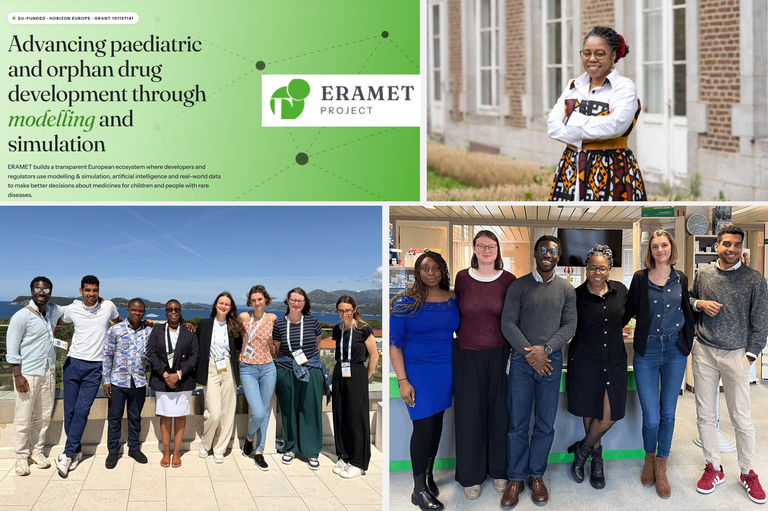
ERAMET: Advancing paediatric and orphan drug development through modelling and simulation
Addressing a critical challenge
Developing medicines for children and people with rare diseases is particularly challenging. Small patient populations can make traditional clinical trials difficult, costly, and in some circumstances, ethically challenging. This may limit the evidence available to support drug development and ultimately delay access to new treatments for patients with high unmet medical needs.
Unlocking the potential of Modelling and Simulation (M&S)
M&S uses mathematical and computational models to represent and simulate the behavior of drugs and biological systems in silico, from the cellular and organ levels to individual patient and populations. By integrating knowledge and data from different sources, M&S can help predict drug exposure and treatment response, optimize doses and clinical trial designs, and support the extrapolation of existing knowledge to populations for whom clinical data are limited.
M&S also provides opportunities to make better use of existing data, including clinical trial data, medical records, registries and other real-world data sources. These approaches can complement clinical studies and help reduce the amount of additional clinical evidence that needs to be generated. However, its use and acceptance by regulators remains variable within the European regulatory framework. ERAMET aims to address these challenges by strengthening the scientific and regulatory foundations for the use of M&S in drug development and regulatory processes.
Building an integrated ecosystem
Funded by the European Union and coordinated by Prof. Flora Musuamba Tshinanu (UNamur, NARILIS), ERAMET brings together a multidisciplinary consortium of 17 partners from Belgium, Norway, the UK, Italy, Spain, France, Greece and the Netherlands. The consortium combines expertise in regulatory science, computational modelling and simulation, data science, bioinformatics, artificial intelligence, machine learning, digital twins and drug development.
ERAMET aims to build an ecosystem supporting both drug developers and regulators in making informed decisions using M&S methods and relevant sources of patient data. At the heart of ERAMET is a question-centric approach, which focuses on answering key questions that arise during drug development and regulatory assessment.
By advancing credible M&S approaches and improving the use and integration of relevant data, ERAMET aims to strengthen evidence generation and regulatory decision-making. Ultimately, this work seeks to support the development of medicines for patients with unmet medical needs.
ERAMET at UNamur-NARILIS
Under the supervision of Flora Musuamba Tshinanu, a multidisciplinary team of researchers at UNamur-NARILIS contributes to the project through different case studies and complementary areas of expertise:
- Hélène Haguet, postdoctoral researcher, is investigating the use of M&S for monoclonal antibodies in moderate-to-severe asthma.
- Majad Mansoor, postdoctoral researcher, is developing AI tools to support and enhance regulatory drug assessment.
- Phanio Djokoto, PhD student and assistant, is working on characterization of QT prolongation and optimization of clinical study designs.
- Camille Massaux, PhD student, is working on the characterization of drug-drug interaction.
- Lisa Hanquet, PhD student, is investigating the use of M&S for CAR-T cell therapies in hematologic malignancies.
- Grace Shalom Govere, PhD student, is investigating the use of M&S for hemoglobinopathies.
- Adrien Olama, PhD student, is investigating the use of M&S for paediatric pain drugs.
- Lisa Wellin, PhD student, is working on bioequivalence.
Two years of progress and more to come
After two years of research, ERAMET is already generating important insights, achievements and milestones. The consortium’s progress and impact are regularly shared through its communication channels:
- Website : https://www.erametproject.eu/
- Linkedin: https://www.linkedin.com/company/eramet-project/posts/
- Instagram: https://www.instagram.com/erametproject/
Stay tuned for the next two years of ERAMET, with new results and deliverables to come.
EU-funded · Horizon Europe · Grant 101137141