 NAmur Research Institute for LIfe Sciences
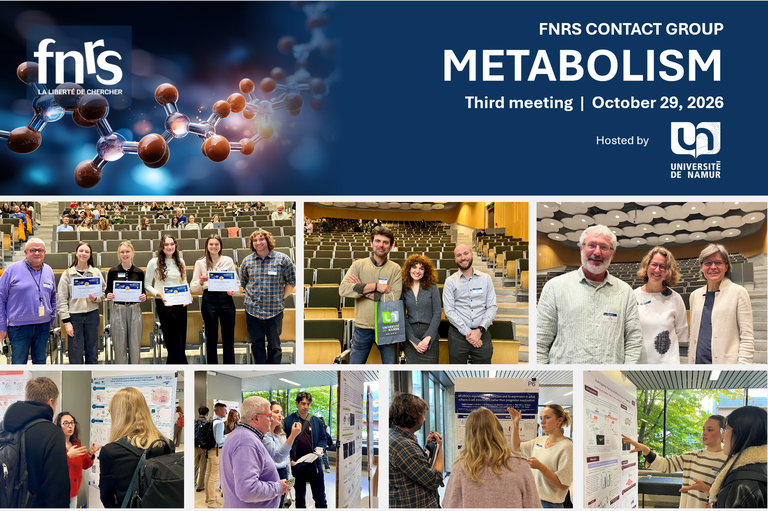
Successful third annual meeting of the FNRS Contact Group “Metabolism” in Namur
Detailed programme | Meeting report
The FNRS Contact Group “Metabolism” aims to connect Belgian and international experts in metabolism research to discuss the latest scientific advances, exchange knowledge and foster collaboration. Its third annual meeting took place at the University of Namur on October 29, 2026, and was organized by Thierry Arnould and Marc Hennequart. The event gathered around 130 researchers, primarily from Belgian universities, including ULB, ULiège, UCLouvain, UNamur, UMons, KU Leuven, UGent and VUB.
A rich scientific programme and stimulating exchanges
Six renowned experts gave inspiring keynote lectures, shedding light on the pivotal role of metabolism in biological processes and its involvement in disease development.
Elisa Motori (University of Cologne) opened the meeting by discussing how mitochondrial stress responses influence neuronal fate and vulnerability as well as how cancer cells exploit neuronal signaling to promote tumor growth, highlighting potential therapeutic targets for neurodegeneration and cancer.
Thibaut Burg (KU Leuven) presented his research on the contribution of metabolic dysfunction to motor neuron degeneration in Amyotrophic Lateral Sclerosis (ALS) caused by FUS mutations, and showing how understanding these processes may lead to novel therapeutic strategies for ALS.
Baptiste Leroy (UMons) shed light on the remarkable metabolic versatility of purple phototrophic bacteria and discussed their metabolic strategies to maintain electron-carbon balance.
Carole Linster (University of Luxembourg) highlighted metabolite repair and damage control as a fundamental pillar of metabolism, focusing on metabolite repair enzymes that convert abnormal or toxic metabolic side-products generated from “faulty metabolism” back to useful metabolites or prevent their accumulation.
Marc Fransen (KU Leuven) discussed the role of peroxisomes as dynamic cellular redox signaling hubs, with a particular focus on how peroxisome-derived H₂O₂ influences metabolic adaptation and inter-organelle communication.
Miriam Cnop (ULB) addressed the role of pancreatic β-cell failure in diabetes and presented her pioneering work on differentiating patient-derived induced pluripotent stem cells into β-cells, offering a highly relevant model for studying disease and discovering novel therapies.
The scientific programme also featured 8 short talks and 38 posters presented by young researchers, giving them the opportunity to present their latest findings, to exchange ideas and receive feedback on their research.
Celebrating the next generation of researchers
The meeting concluded with the presentation of oral communication and poster awards, recognizing outstanding contributions of early-career researchers:
🏆 Best Oral Communication to Anisa Aliju, PhD student at ULiège in the team of Arnaud Blomme, for her short talk entitled “Metabolic control of mRNA translation as a vulnerability in lung cancer”.
🏆 Best Oral Communication to Florine Habets, PhD student at ULiège in the team of Stéphanie Herkenne, for her short talk entitled “Mitochondrial protein VDAC1 regulates angiogenesis by tethering Mitochondrial-Derived-Vesicles and early endosomes”.
🏆 Best Poster Presentation to Hanne Verhaeghe, PhD student at KU Leuven in the team of Philippe Van den Steen, for her poster entitled “Role of complement factor 3 and hepatic mitochondrial dysfunction in severe malaria-associated dysmetabolism”.
🏆 Best Poster Presentation to Kaylee Morris, PhD student at the University of Cologne in the team of Elisa Motori, for her poster entitled “The role of neuron-cancer metabolic interactions in small cell lung cancer”.
The organizing committee warmly thanks the FNRS for its support, as well as all the sponsors whose contributions helped make this event possible: Bio-Connect, CliniSciences, Elscolab, LICORbio, Merck, Morpho Biotech, Proteintech, VectorBuilder and VWR.