 NAmur Research Institute for LIfe Sciences
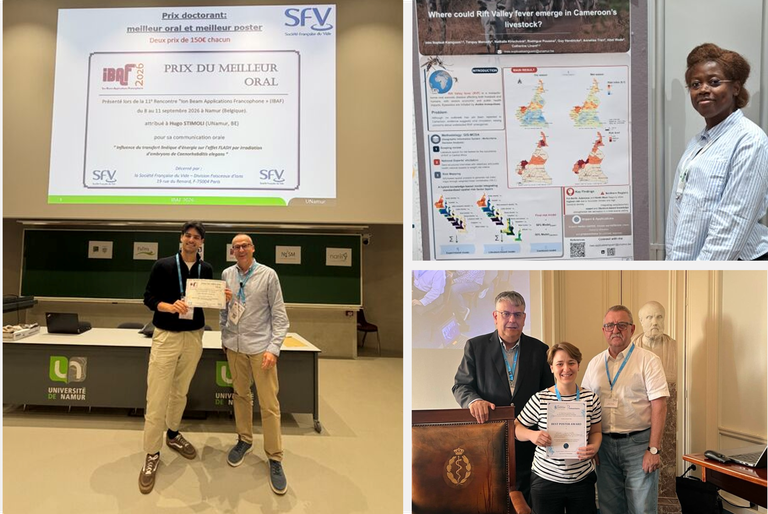
Three young researchers from NARILIS awarded at international scientific meetings
🏆 Inès Sopbué Kamguem receives Best Poster Award voted by the Public at EPIZONE 2026
Inès Sopbué Kamguem, a PhD student in Catherine Linard’s research group, was awarded the Best Poster Award voted by the Public at the EPIZONE 2026 conference, held in Bern on September 2-4, 2026. She was recognized for her poster presentation and one-minute poster slam entitled "Mapping Rift Valley fever emergence risk in Cameroonian livestock".
Catherine Linard’s research group applies geographical tools and approaches to tackle health‐related questions, with a particular focus on vector-borne and zoonotic diseases.
Inès’ doctoral research focuses on mapping areas of Cameroon at risk of Rift Valley fever (RVF) virus and Ebola virus emergence, two emerging zoonotic pathogens with high epidemic potential. Her work seeks to identify high-risk areas for RVF emergence in livestock, and suitable areas for Ebola virus spillover to humans, at a spatial resolution of 1 km² and a temporal coverage from 2010 to 2025. Her work will help support more targeted prevention and surveillance strategies for RVF and Ebola virus disease in Cameroon.
🏆 Hugo Stimoli receives Best Oral Communication Award at IBAF 2026
Hugo Stimoli, a PhD student in Anne-Catherine Heuskin’s research group, was awarded the Best Oral communication at the 11th edition of Rencontres Ion Beam Applications Francophones (IBAF), held in Namur, on September 8-11, 2026. He was recognized for his talk entitled “Influence du transfert linéique d'énergie sur l'effet FLASH par irradiation d'embryons de Caenorhabditis elegans”.
Anne-Catherine Heuskin’s group conducts research in radiobiology, exploring how cells respond to ionizing radiation, with the aim of improving cancer radiotherapy. A major focus of the team is FLASH radiotherapy, an emerging approach based on delivering radiation at ultra-high dose rates (UHDR, >40 Gy/s), which can maintain tumor control while causing less damage to healthy tissues than conventional radiotherapy. Hugo’s work investigates the FLASH effect using Caenorhabditis elegans, a microscopic nematode that provides a convenient in vitro model thanks to its ease of maintenance, short developmental cycle, and well-characterized behavioral responses. As part of his work, C. elegans embryos are irradiated using the UHDR irradiation platform set up on the ALTAÏS accelerator. Hugo’s research opens new perspectives for understanding the radiobiological mechanisms underlying the FLASH effect, and ultimately, its potential applications in cancer treatment.
🏆 Lucie Caramelle receives Best Poster Prize at the 15th International Calreticulin Workshop
Lucie Caramelle, a postdoctoral researcher in Alison Forrester’s research group, was awarded the Best Poster Prize at the “15th International Calreticulin Workshop: Endoplasmic Reticulum and Protein Folding in Health and Disease”, held in Brussels on September 21-23, 2026. She was recognized for her poster and flash presentation entitled “Drugging the Endoplasmic Reticulum Exit Sites”.
Alison Forrester’s lab investigates protein trafficking in the early secretory pathway, focusing particularly on the export of native proteins from dedicated areas of the endoplasmic reticulum (ER), called ER exit sites (ERES). ER exit is a tightly controlled process, and its deregulation can impair protein secretion and contribute to several diseases, the most common being fibrosis. The therapeutic potential of targeting ERES was first demonstrated through the discovery of Retro-2, a specific pharmacological inhibitor of ERES. Lucie’s postdoctoral research aims to identify new compounds capable of modulating ER-to-Golgi trafficking of secreted proteins. Using advanced microscopy, she is investigating how modulating ERES function affects protein trafficking and cellular homeostasis, paving the way for new therapeutic strategies.